
Most business owners track their bank balance more closely than their financials.
And while your bank account tells you what you have today…
…it tells you nothing about what’s coming three weeks from now.
That’s where the stress comes from.
- “Can I afford to hire?”
- “Why does cash feel tight even when revenue is strong?”
- “Are we about to hit a problem I don’t see yet?”
At a certain level—whether you’re pushing past $5M or scaling toward $25M—
the biggest threat to your business isn’t revenue.
It’s not knowing what’s ahead.

Why “I Think We’re Fine” Is a Dangerous Strategy
In growing businesses, uncertainty doesn’t show up all at once.
It builds slowly.
You start relying on:
- Your gut
- Your current bank balance
- Best-case assumptions
And over time, decision-making gets heavier.
Hiring feels riskier.
Investments get delayed.
Confidence starts to erode—even when the business is performing well.
Because without visibility, even strong businesses feel unstable.
The Tool That Changes Everything (If You Use It Right)
This is where the 13-week cash flow forecast comes in.
Not as a report.
Not as a finance exercise.
But as a decision-making tool.
At its simplest, it gives you a forward-looking view of:
- What cash is actually coming in (and when)
- What’s going out (and how it stacks)
- Where problems will show up—before they happen
And that’s the shift:
From reacting to what already happened…
→ to leading what happens next
Why 13 Weeks Is the Sweet Spot
Why 13 weeks?
Why not a monthly budget or an annual projection?
Because 13 weeks (one quarter) is where accuracy and strategy meet.
- Long enough to see meaningful trends
- Short enough to stay grounded in reality
- Aligned with how businesses actually operate
A 12-month forecast is mostly assumptions.
A 13-week forecast is operational truth.
There’s nowhere for issues to hide.
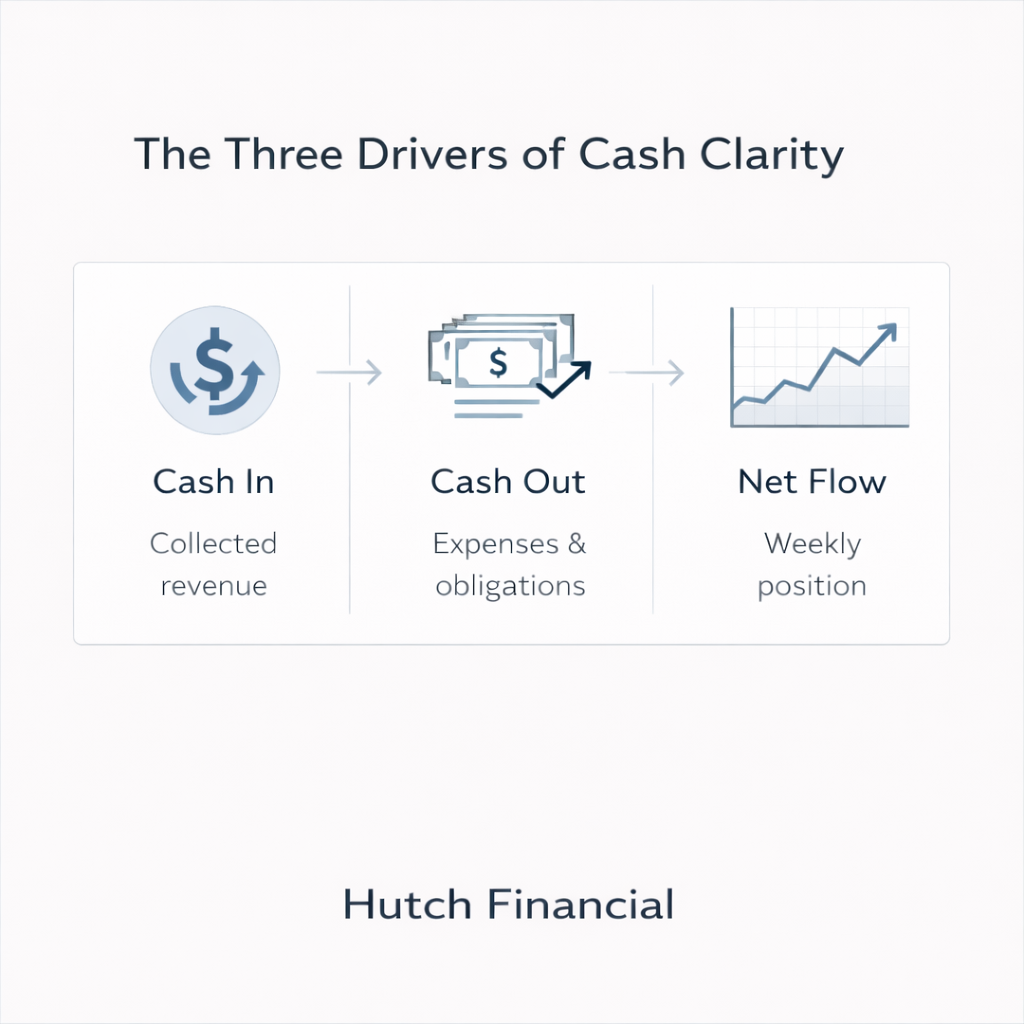
To build a forecast that actually works, you need to break your business into three core components.
Get these right, and the fog lifts quickly.
1. Cash In: What Actually Hits Your Account
Revenue is not cash.
Sales don’t matter until they’re collected.
The key question is:
When does money actually show up?
That means:
- Looking at real payment behavior
- Understanding delays (30, 45, 60+ days)
- Identifying slow-paying clients
The most accurate forecasts are built on collections—not invoices.
2. Cash Out: The Full Picture (Not Just the Obvious)
Most businesses underestimate outflows.
They remember:
- Payroll
- Rent
But forget:
- Annual renewals
- Quarterly taxes
- Equipment, bonuses, or debt payments
A strong forecast includes:
- Fixed costs (rent, salaries)
- Variable costs (COGS, marketing)
- Lumpy costs (taxes, large one-time expenses)
Because the surprises are what create the stress.
3. Net Cash Flow: Your Weekly Reality Check
This is where it all comes together.
Week by week, you can see:
- Where cash builds
- Where it drops
- Where decisions need to be made
Seeing a problem in Week 7—today—gives you time to act in Week 2.
That’s the advantage.
How to Build a Forecast That Actually Works
You don’t need a complex system.
But you do need discipline.
Step 1: Start with What’s True Today
Pull:
- Current bank balances
- Accounts receivable (who owes you and when)
- Accounts payable (what you owe and when)
- Payroll and debt schedules
This is your baseline.
Step 2: Forecast Conservatively
This is where most forecasts break.
A simple rule:
- Be conservative with inflows
- Be aggressive with outflows
If you think a client will pay in 3 weeks → forecast 4
If you think something will cost $10k → forecast $12k
This builds a buffer—and protects your decisions.
Step 3: Run Scenarios Before You Need Them
Once your base forecast is built, ask:
- What happens if revenue slows for 3 weeks?
- What happens if a deal closes early?
- What happens if expenses spike unexpectedly?
Running these scenarios removes emotion from decision-making.
You already know your next move.
From Spreadsheet to Strategy: The Weekly Rhythm
This is where most businesses fall short.
A forecast isn’t “set it and forget it.”
It’s a weekly operating rhythm.
Each week:
- Compare what you expected vs. what actually happened
- Adjust your assumptions
- Roll the forecast forward another week
This creates a feedback loop.
And over time, your accuracy—and confidence—improves dramatically.
What This Changes for You as a Founder
Without a forecast:
- Decisions feel heavy
- Timing feels uncertain
- You rely on instinct
With a forecast:
- You see challenges before they hit
- You act earlier
- You make decisions with confidence
You stop operating reactively.
And start leading intentionally.

Turning Visibility Into a Competitive Advantage
You can’t control the economy.
You can’t control when a client pays.
But you can control how prepared you are.
The businesses that scale aren’t the ones that avoid problems.
They’re the ones that see them early and act decisively.
A 13-week forecast gives you that edge.
It turns uncertainty into a plan.
Stop Guessing. Start Leading.
If you feel like your business is performing—but still lacks clarity—you’re not alone.
Most owners don’t need more effort.
They need better visibility.
👉 If you’re ready to get out of the fog and start making decisions with confidence, building a 13-week cash flow forecast is the place to start.
If you want a second set of eyes on your numbers—or help building a system that actually drives decisions—we’re always happy to help. Schedule a call today.